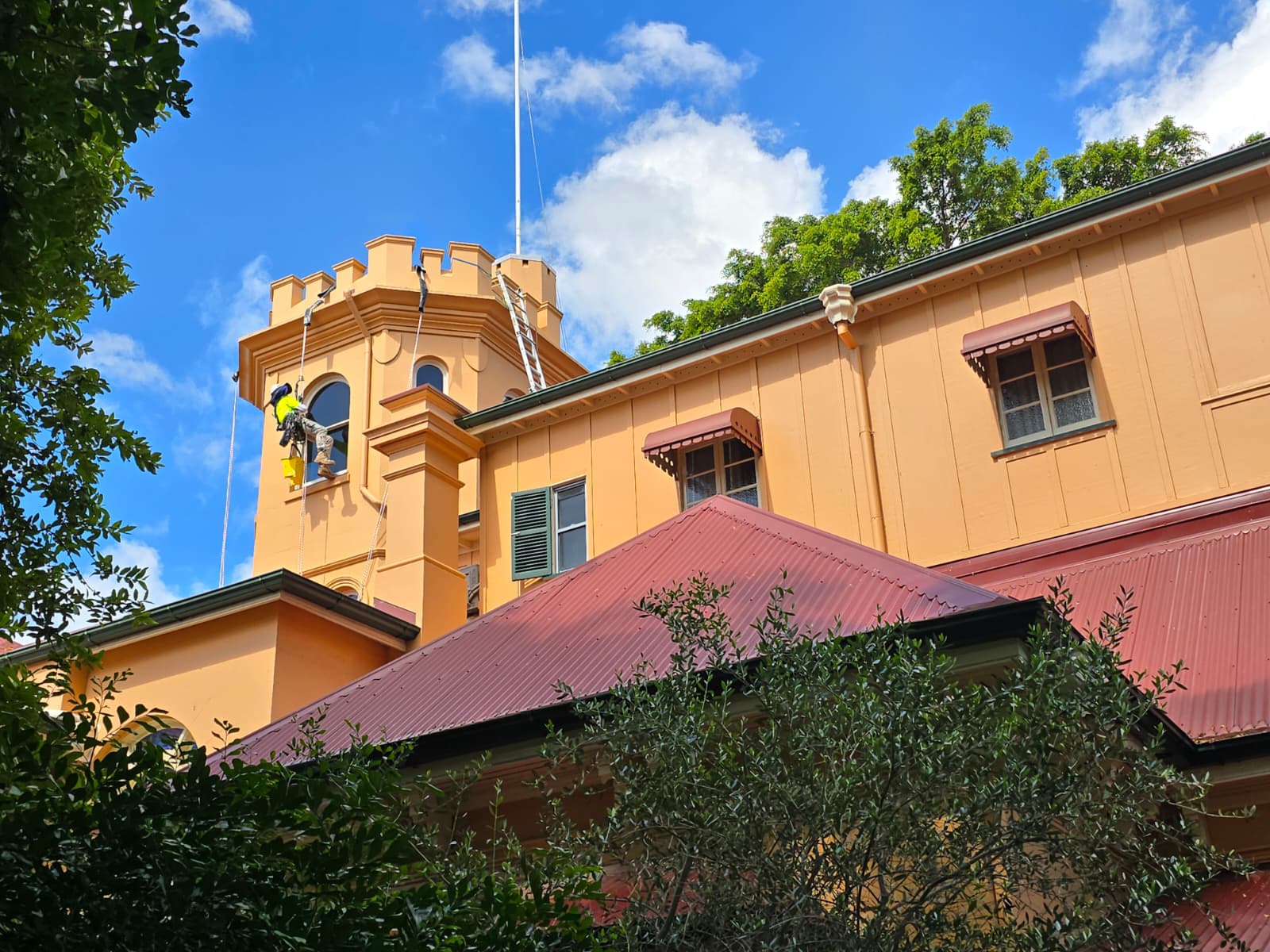
Rope access painting is a safe, well-regulated way to reach tall buildings when it’s done by trained technicians using two independent ropes and tested anchors. If you’re hiring a team, the three things worth understanding are IRATA levels, the two-rope system and anchor testing.
What IRATA is
IRATA, the Industrial Rope Access Trade Association, is the international body that sets training and assessment standards for rope access technicians. Its certification is widely recognised across construction, inspection and maintenance work. Technicians keep a logbook of their hours, and certification has to be renewed by reassessment.
In Australia, industrial rope access systems are also covered by the AS/NZS 4488 standard. Together, these give building owners something concrete to check when they’re comparing contractors.
The three IRATA levels
Level 1 is a rope access technician. They carry out tasks on the rope under the supervision of a higher level.
Level 2 is an experienced technician who can rig ropes and carry out rescues, working with a Level 3 supervisor.
Level 3 is the supervisor. They’re responsible for the worksite, including the rope system, the safety of the team and the rescue plan.
When you ask about a team’s credentials, don’t stop at “are you IRATA certified?” Ask how many technicians are on the job, what levels they hold and who the Level 3 supervisor is. That’s what actually tells you how the work will be run.
Why there are always two ropes
The core safety principle of rope access is redundancy. Every technician works on two separately anchored ropes: a working line that carries them, and a backup line that catches them if anything goes wrong with the first. If one fails, the other is already in place.
Technicians also work in teams, so there’s always someone ready and trained to carry out a rescue. That’s why rope access has a strong safety record when it’s run properly, and why the level of supervision matters so much.
Anchors and why they’re tested
The ropes are only as safe as the points they’re attached to. On buildings, anchors have to be fit for purpose, installed correctly and inspected on a regular schedule. If a building has permanent anchor points, they should have current test certification. If not, temporary anchors need to be rigged and checked by competent people before any work starts.
We offer anchor testing and height safety systems as part of our rope access services, and we test equipment as well. Building managers often ask us to check anchors before a painting job so the two can be planned together.
What a rope access painting job looks like
Rope access painting starts with a site assessment, a safe work method statement and a rescue plan. Technicians descend the facade, prepare the surface, apply the coatings and inspect as they go. Because there’s no scaffold or platform to erect, set-up is quick and the ground footprint is small.
It suits tall buildings, tight sites and areas where scaffold would be slow or disruptive. Our guide to rope access and abseil painting in Brisbane and our comparison of abseiling and scaffolding explain when it’s the better option.
Questions to ask a rope access contractor
- Which IRATA levels does the team hold, and who’s the Level 3 supervisor?
- What’s the rescue plan for this building?
- How are anchors checked, and when were they last tested?
- Can you provide a site-specific SWMS?
- What insurance covers work at heights?
Look for the supervision, not just the certificate
A certificate shows training. A good supervisor shows how the job will actually run. Our high-rise painting guide covers what building managers need to organise, and our post on the paperwork a commercial painter should show you lists the rest. See our rope access painting services, then request a quote or call 1300 733 447.
McAuliffe Painting. Eagle Farm, Brisbane QLD 4009. QBCC Lic 15183972.